Native Andean Ingredients from the Sacred Valley: A Guide
Exploring these indigenous crops reveals how ancient agricultural engineering shaped global food supplies. The terrace systems, microclimate experimentation, and seed preservation practices developed in this region continue to nourish communities today.
Which native Andean ingredients from the Sacred Valley lead Peruvian cuisine?
The agricultural richness of the Sacred Valley forms the bedrock of traditional mountain diets and contemporary fine dining menus across Peru.
High-elevation crops must endure freezing night temperatures and intense daytime UV exposure, resulting in concentrated flavors and exceptional nutritional profiles.
Tubers, pseudograins, and natural minerals represent the three pillars of Andean pantry staples.
- Kiwicha and Quinoa: Ancient gluten-free grains prized for complete protein structures and essential amino acids.
- Tarwi: High-protein Andean legumes historically used to enrich mountain stews.
- Ulluco and Oca: Brightly colored root vegetables offering crisp textures and tangy, sweet flavors.
These superfoods sustained complex civilizations long before modern agricultural technology existed. Nutritional density makes Andean produce unique, inspiring health-conscious chefs worldwide.
Why are thousands of native potato varieties vital to Andean gastronomy?
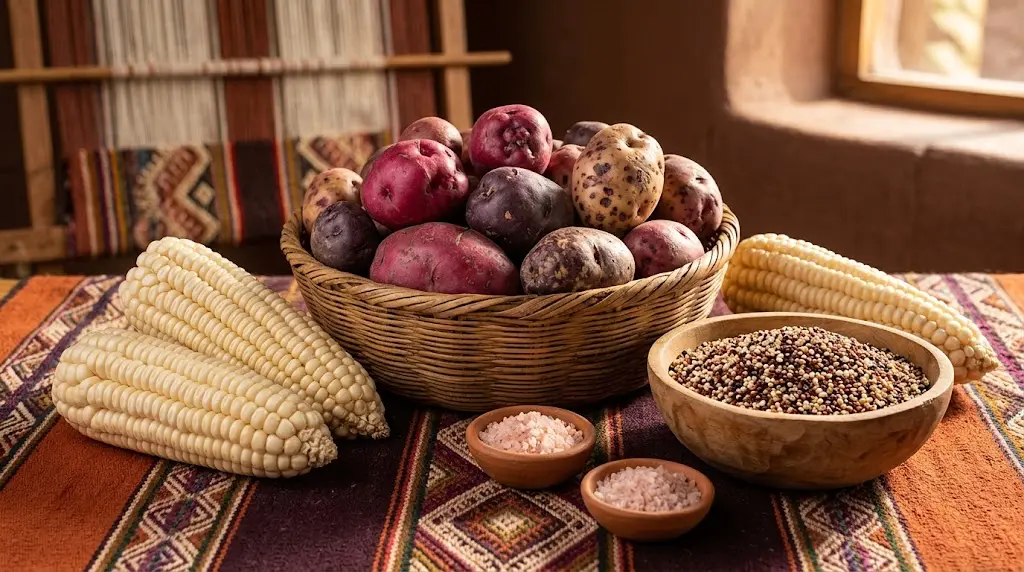
Peru is the ancestral birthplace of the potato, harboring over three thousand cultivated varieties ranging in color from deep purple to vibrant orange.
In the high-altitude fields of the Sacred Valley, indigenous communities steward heirloom potato species tailored to specific micro-elevations and cooking methods.
When visiting notable places in Peru, sampling native potato tasting platters reveals textures and flavors completely absent from commercial grocery strains.
Preservation of agricultural heritage
There is an astonishing difference between a standard commercial potato and a native Huayro or Camotillo potato baked in mountain soil.
Using traditional freeze-drying methods to create chuño allows mountain families to preserve starch reserves for years without refrigeration.
How is Sacred Valley giant white corn cultivated and prepared locally?
The oversized giant white corn of Urubamba (*Paraqay Sara*) is a protected agricultural species that grows exclusively in the specific microclimates of the Sacred Valley.
Featuring massive, tender kernels, this legendary grain has been cultivated since Inca nobility designated the valley as their primary breadbasket.
- Choclo con Queso: Boiled giant corn served alongside fresh, salty Andean farmer’s cheese.
- Chicha de Jora: Traditional fermented corn beer crafted according to ancient communal recipes.
- Sopa de Maíz: Rich, hearty corn soup thickened with native herbs and mountain broth.
Strict microclimate conditions govern corn cultivation. Attempts to grow giant white corn outside this specific valley floor result in smaller, tougher kernels, proving the irreplaceable nature of this terroir.
What makes Maras pink salt a prized treasure in high-altitude cooking?
Nestled into the terraced slopes of Qoripukyu near Maras, thousands of hand-carved evaporation ponds harvest natural pink spring salt as they have for over a millennium.
Hyper-saline water emerges from a subterranean thermal spring, filling shallow clay pans where mountain sunlight gradually evaporates the moisture, leaving mineral-rich salt crystals behind.
- Contains high concentrations of magnesium, iron, calcium, and zinc derived from ancient rock strata.
- Hand-harvested by local cooperative families using traditional wooden scrapers.
- Delivers a delicate crunch and mild mineral finish preferred by top international chefs.
Mineral purity elevates simple ingredients to extraordinary levels. Sprinkling hand-harvested Maras pink salt over roasted native tubers creates a direct flavor link to the ancient geography of the Andes.